From OKRs to Outcomes: Key Takeaways from Our Panel
Darren Celliers
18 June, 2026

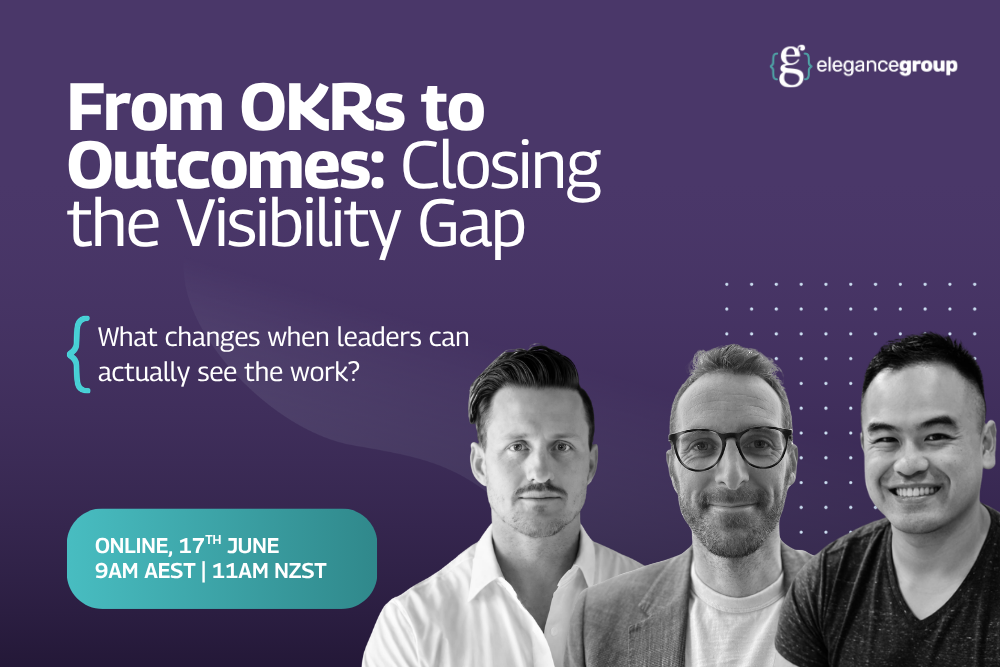
On June 17, we hosted a panel conversation on one of the most persistent challenges we hear about from leaders across ANZ: most organisations have a strategy, but very few have a clear line of sight between that strategy and what their teams are actually working on day to day.
No slide decks. No scripted demos. Just a genuinely honest discussion between Clayton Coetzee (Senior Consultant, Elegance Group), Brandon Huang (Solutions Engineer, Asana), and Lachlan Drummond (Head of Value Engineering, Woolworths Group), who has been running a quarterly OKR-based delivery cycle inside one of Australia’s most complex organisations for years.
Here are the themes that stood out.
1. The gap between strategy and execution is real, and most organisations know it
The conversation opened with a simple but uncomfortable truth: writing objectives is one thing, keeping teams pointed toward them through a full quarter is something else entirely. Work takes over. Priorities shift. And before you know it, you reach the end of the quarter and realise the goals quietly disappeared somewhere in the noise.
Lachlan was candid about what it looked like before Woolworths built a proper quarterly delivery cycle. Large programs were being tracked across Google Sheets and a few good intentions, and no one had a clear picture of where things actually stood.
Brandon added that this pattern shows up right across the ANZ organisations he works with, regardless of size. The problem isn’t usually that people don’t care about the strategy. It’s that the day-to-day work isn’t connected to it in any meaningful way.
2. OKRs are a culture question as much as a framework question
One of the most useful threads in the session was the distinction between organisations that do OKRs and organisations that have actually built a culture around them.
Brandon framed it directly: are your OKRs seen by your team as work about work, or as a genuinely useful tool? If people are just filling in boxes, you’ve probably got a culture problem more than a process problem.
That culture question shapes everything else: how goals get set, how failures get treated, and whether people actually engage with the process or just go through the motions. A few things that tend to create the right environment came up across the session, and they’re worth unpacking separately below.
3. Individual buy-in matters as much as leadership commitment
Brandon raised a point that doesn’t always get enough airtime in OKR conversations: the framework will stall if individuals can’t answer two questions for themselves. Why is this important? And why is this important to me?
Without clear answers to both, people default to their old ways of working. They copy their existing habits into the new tool or process, it starts to feel like extra overhead, and adoption quietly falls apart. The tool becomes work about work rather than where the work actually happens.
This is as much a communication challenge as a process one. It means being deliberate about framing the change for your team, not just rolling out a framework and assuming people will see the value. Lachlan’s approach at Woolworths was to demonstrate value organically with a small team first, let other teams notice the results, and let curiosity drive adoption rather than mandating it from the top.
4. Start small and don’t wait for perfect
There’s a version of OKR implementation that goes like this: someone kicks things off, a working group forms, months are spent debating what good looks like, and eventually the whole thing either launches with fanfare and dies quietly, or never launches at all.
Brandon called this out as one of the most common mistakes he sees. Don’t over-engineer it. Don’t wait for the perfect framework before you begin. Just start with a small working group, set some objectives, define a few KRs, and see what you learn.
Lachlan’s story at Woolworths backed this up. Rather than mandating the tool and the process across the organisation from day one, he started using Asana with a small team, demonstrated some tangible results (including shaving four weeks off a forty-week project), and let other teams come to him when they noticed. That organic adoption eventually built into over a thousand active users.
The analogy Brandon reached for: stop debating how to build the bike shed. Just build something that works, collect data points, and adjust as you go.
5. Set goals that stretch, but don’t break confidence
One of the more practical exchanges in the session was around how to calibrate key results. Brandon used an analogy from his kinesiology background: if a physio sets goals that are too easy, the patient doesn’t push themselves. Set them too high and the patient gives up. The same logic applies to KRs.
The aim is to stretch the team without damaging confidence. Some organisations have landed on 80% as their success threshold, specifically to encourage genuine stretch goals rather than sandbagging. Getting 80% of the way to an ambitious target is often a better outcome than hitting 100% of a conservative one.
Brandon also made the point that OKRs shouldn’t be tied to individual performance reviews. When people know their KR attainment is going to show up in their rating, it drives conservative goal-setting and a fear of failure. OKRs work best as a tool for direction and conversation, not as a measurement stick for the individual.
6. Alignment is a habit, not a meeting
Getting the OKR framework in place is one part of it. Keeping the cadence alive through the quarter is where most organisations fall down.
At Woolworths, this means regular mid-quarter check-ins, a PMO team that keeps things honest, and a fortnightly status update rhythm alongside a team retrospective every three weeks. It’s not glamorous, but it’s what turns a planning exercise into an actual way of working.
Brandon made a useful point about silence: when there are no regular updates, stakeholders fill the gap with assumptions and anxiety. Regular, transparent updates give teams control of the narrative and reduce the mental load on everyone else trying to understand what’s happening.
7. Use leading indicators, not just lagging ones
Most teams default to lagging indicators, which only tell you whether you hit the target after the fact. By then, it’s too late to course-correct.
Clayton shared an example from organisations he’d worked with that had introduced leading indicators alongside their lagging ones. If the outcome is growing customer retention, a lagging indicator is your retention rate at quarter end. A leading indicator might be weekly product engagement scores, because if engagement is dropping mid-quarter, you have an early signal that retention is at risk before the quarter closes.
Building both types of indicators into your KR tracking means you can see whether you’re on track while there’s still time to do something about it. It shifts the whole exercise from a scorecard you review at the end to a live instrument you actually navigate with.
8. It’s not really about the tool
Probably the most consistent message across the whole conversation was this: the structure and the alignment matter more than which platform you use.
If you treat the tool as the thing that solves the problem, you’ll set yourself up to be disappointed. But if you use the tool to reinforce a way of working that you’ve already committed to building, it starts to pay off in ways that are hard to achieve any other way.
Lachlan made the point practically: when his manager pings him asking for a status update, he can just send a link to the Asana project and let the work speak for itself. That’s what good looks like.
What’s next?
If you want to dive deeper, you can get the full recording to watch on-demand here. And if anything from this conversation sparked a question about how it applies to your organisation, get in touch with our team. We’re happy to have a no-obligation conversation.
Finally, if you’d like to actually see Asana’s goal management and OKR features in action, Brandon is hosting a separate live demo session covering exactly that. Register your interest for that here.
Recent Posts

What Shipped in August: Atlassian, Asana and ClickUp All Made the Same Bet

Atlassian Is Putting AI and Automation on a Meter: Here's What's Changing and What To Do About It