Why Integrated Service Desks Resolve Tickets 14% Faster
Brett Celliers
04 May, 2026

There’s a version of IT service management that most organisations know too well. A ticket comes in. It gets logged. Someone chases context from one system, then another. A resolution that should take hours stretches into days, not because the team isn’t capable, but because the tools aren’t talking to each other.
It’s a frustratingly common story. And it turns out, the data puts a very specific number on what it costs you.
The Integration Gap is a Performance Gap
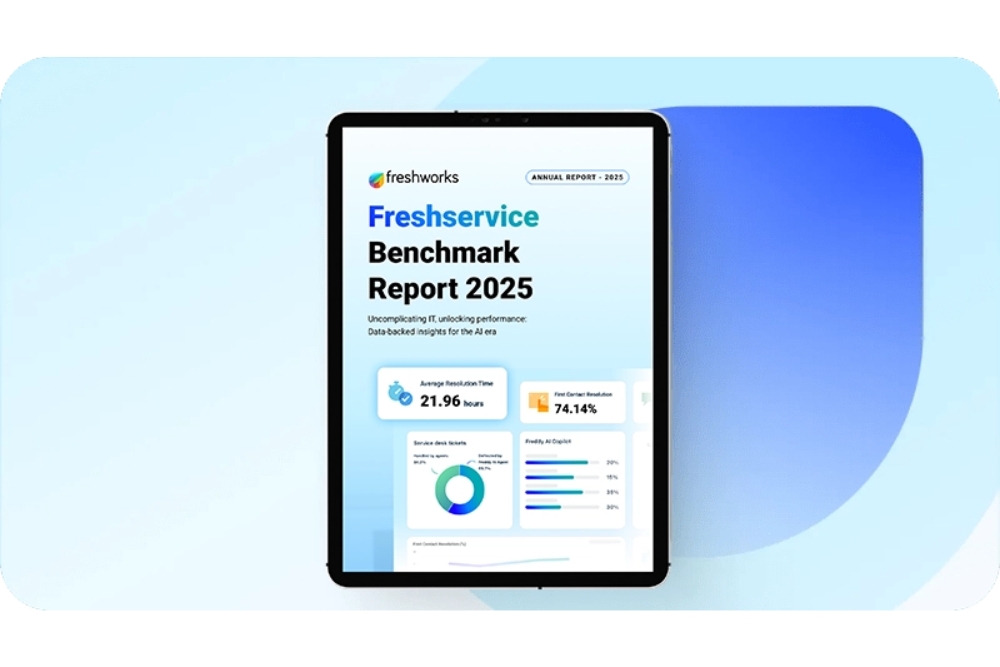
The 2025 Freshservice Benchmark Report, which analysed over 187 million tickets across 10,743 organisations in 118 countries, found a clear and consistent relationship between integration depth and service desk performance.
Organisations with integrations enabled recorded a 6.89% drop in average resolution time compared to those without. But here’s where it gets more interesting: when you compare teams running just 1–5 integrations against those with 11 or more, the gap widens to 14.23% faster resolution times. SLA adherence also improved; resolution SLA climbed to 97.08% and first response SLA to 97.04% for the most integrated teams.
That’s not a marginal difference. For a team handling hundreds of tickets a week, a 14% reduction in resolution time is the equivalent of getting back significant hours of capacity, every single week.
Why Does Integration Make Such a Difference?
The answer is less technical than you might expect. It comes down to context.
When your service desk is connected to your HR system, your asset management platform, your identity provider, and your collaboration tools, your agents don’t have to go hunting. They can see who raised the ticket, what device they’re using, what access they have, and whether there’s a pattern with similar issues, all from a single interface. That context collapses the time between “ticket received” and “ticket resolved.”
Without it, agents fill the gap manually. They ask clarifying questions that should already be answered. They switch between systems to piece together a picture. They duplicate effort across teams who each only have part of the story. Every one of those steps is a friction point, and friction compounds.
The Freshservice data bears this out. First contact resolution, resolving an issue in a single interaction without the back-and-forth, was highest for teams with 6–10 integrations, reaching 77.89%. Compare that to 73.98% for teams with no integrations. Nearly four percentage points may not sound dramatic, but at scale, it represents thousands of tickets that get resolved first time instead of bouncing.
This Isn’t an Enterprise-Only Play
One assumption worth challenging: that deep integration is the domain of large IT teams with dedicated engineers and long implementation timelines. The benchmark data suggests otherwise.
Organisations of every size saw measurable performance improvements from connecting their tools. The gains weren’t exclusive to enterprise. They were consistent, which means the opportunity exists whether you’re running a lean IT team of five or a service desk serving thousands of employees.
The barrier isn’t scale. It’s often a starting point. Many organisations are still running on platforms that were never designed to integrate easily, where every new connection requires custom development, ongoing maintenance, and a specialist who knows where all the wires are. That’s a different problem, and one worth naming directly.
The Real Cost of Disconnected Tools
A fragmented tech stack doesn’t just slow your service desk down. It accumulates costs that rarely appear in a single line item. There’s the time agents spend navigating systems. The errors that come from re-entering data manually. The delays caused by waiting on teams who hold context in a different platform. And the employee experience that suffers when a simple request becomes a multi-day saga.
The 2025 Freshservice Benchmark Report puts the broader picture in sharp focus: organisations that simplified their environments — consolidating platforms, deepening integrations, extending automation — consistently outperformed those that didn’t. Not just on IT metrics, but on the outcomes that matter to the business: satisfaction scores, SLA adherence, and resolution speed.
As the report’s authors put it: "the teams that are winning today are those that are simplifying. Not by stripping back capabilities, but by eliminating complexity."
Want To Go Deeper?
These findings raise a question that’s harder to answer from a report alone: what does the path from fragmented to integrated actually look like in practice? What do organisations get wrong in the process, and what do the successful ones do differently?
That’s exactly what we’ll be exploring at our upcoming panel discussion, Modern Service Management: Reducing Cost and Complexity, on 7 May 2026. Joining us online will be experts from Freshworks, the team behind this benchmark data, alongside organisations who have navigated platform consolidation firsthand.
No slide decks. No product demos. Just practical discussion and real experiences.
Register here
The 2025 Freshservice Benchmark Report is based on analysis of 187 million+ tickets across 10,743 organisations in 118 countries, covering the period January–December 2024.
Recent Posts

The Jira Life Down Under: Key Takeaways from Our Session on Atlassian's Pricing Changes
What Shipped in August: Atlassian, Asana and ClickUp All Made the Same Bet