Your AI Is Only As Smart As What It Can See
Brett Celliers
19 October, 2026

Ask most people what they think of their workplace AI and you’ll hear some version of “it’s fine, but it could be better.”
It’s not usually a model problem. The models are very good now. It’s usually a context problem. Your AI doesn’t know how your organisation actually works, because the knowledge it needs is scattered across a dozen tools, half-finished docs and people’s heads.
Which raises a big question for anyone buying AI right now. If context decides how useful your AI is, where should that AI live?
Let’s look at what the research says, the two main answers vendors are giving, and how to think about it for your own organisation.
The New Hire Problem
Atlassian’s Teamwork Lab surveyed 1,002 US knowledge workers earlier this year. Only 12% said their AI understands their company like a senior employee would. 45% said it’s more like a new hire.
The gap matters. Workers whose AI understood their work were up to six times more likely to find it helpful. And while 77% said it was important for AI to understand their organisation’s institutional knowledge, only 21% said it actually did.
So who fills the gaps? People do. Copying, pasting, re-explaining, double-checking.
From Prompt Engineering to Context Engineering
For a while the advice was to get better at prompting. That’s shifted. Shopify CEO Tobi Lutke described it as “the art of providing all the context for the task to be plausibly solvable by the LLM”, which he called context engineering.
As ClickUp’s guide to context engineering points out, MIT research reported by Fortune found 95% of enterprise GenAI implementations fall short. Not because the models are weak, but because AI was never properly connected to the way work actually happens.
It’s not the model. It’s what the model can see.
Two Vendors, One Argument
Here’s the interesting bit. Atlassian and ClickUp both agree on the diagnosis. AI should live where your context already lives.
They just each think that place is them.
- Atlassian’s answer: Rovo, sitting on top of its Teamwork Graph, connecting Jira, Confluence and third-party apps so AI can see across the work.
- ClickUp’s answer: consolidate tasks, docs, chat and AI into one workspace. Its pitch is that “60% of work is lost in context” when it’s spread across too many tools.
Neither is wrong. They’re just different bets on where your organisation’s centre of gravity sits.
Embedded or a Single Layer?
In practice, most organisations end up somewhere between two models. Here’s how they tend to play out:
- AI embedded in each tool: deep context within that tool, and it inherits the permissions you’ve already set. The catch is that each AI only sees its own patch, and you pay a separate meter for each one.
- One AI layer across tools: a single view across everything, with one place to govern and budget. The catch is that connectors are often shallower than they look in the demo, and you’re placing a bigger bet on one vendor.
Which is right for you depends on how many core platforms you run, where your most valuable knowledge sits, and how much consolidation you’re willing to do.
Context Quality Still Matters
Wherever AI lives, it’s only as good as what you feed it. Atlassian’s CAFE(S) framework is a handy checklist for this:
- Clarity: the AI interprets requests as intended.
- Actionability: it knows the goal, the constraints and what done looks like.
- Fidelity: the information is accurate and current.
- Efficiency: high signal, low noise, no wasted tokens.
- Security: safe for an agent to access, with trusted instructions kept separate from untrusted data.
Our favourite line from it: “Context can be clear but not faithful, describing the system as it was rather than as it is.” Out-of-date documentation was always annoying. With agents acting on it, it becomes a liability.
What We’ve Seen Work
We can’t see your setup from here, but these patterns come up again and again:
- Map where your context lives before choosing where AI lives. Which platforms hold the knowledge people actually rely on? Start there.
- Consolidate where it makes sense. Fewer, better-connected platforms give AI one source of truth to work from, instead of several half-pictures.
- Give knowledge an owner. Context with no owner goes stale. Treat key pages and processes like code, with someone responsible for keeping them current.
- Judge AI on your data, not the demo. Every assistant looks smart on a tidy sample workspace.
Where it doesn’t hold up: consolidation for its own sake. If two teams genuinely need different tools, forcing them onto one platform just to make the AI happier will cost you more in adoption than you gain.
Hear It From People Doing It
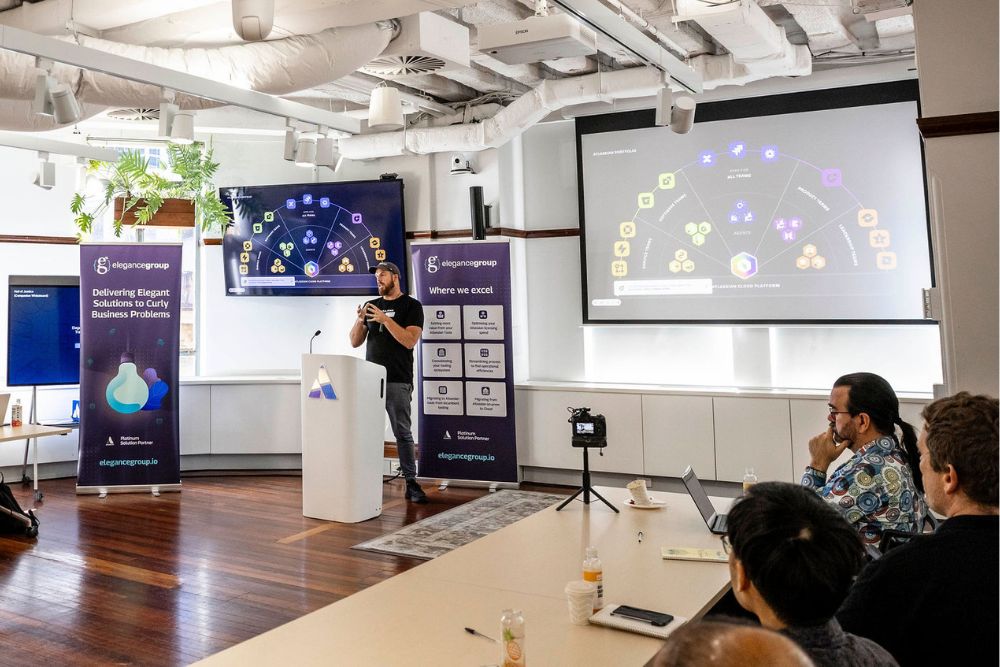
This is the core question at our breakfast panel, Where Should Your AI Actually Live?, later this month at Icehouse in Parnell. Tim Warren, Justin Flitter and Barfoot & Thompson CIO Simon Casey will debate embedded AI versus a single layer, with ClickUp’s Jess Blake adding the vendor view and our founder Brett Celliers hosting.
No slides. Just an honest conversation over breakfast. Register here.
Recent Posts
Tokenmaxxing and the AI Bill Nobody Budgeted For
What Shipped in September: The AI Meter Started Running